

RecFest 2026 was my fourth year going, and Jamie Leonard and the team knocked it out of the park once again. Taking a recruitment conference and mashing it together with a summer festival is no small task — but thousands of talent acquisition and employer brand people in a field at Knebworth showed that it just works.
This year I went to find out what’s on the minds of TA and EB people right now — and, more importantly, what they’re doing about it — so I could share it here.
Here’s how the day unfolded, plus my own takes along the way.
Doing AI vs Doing AI properly — compliance
Before I’d even got through the gates, I bumped into a few people I know and had the kind of catch-up where you spend the first few minutes trying to work out when you last saw each other. I asked one of them, someone who talks to senior people leaders every day, what crops up the most in conversations.
Their answer, unprompted: AI — but specifically AI compliance. They told me about someone who was asked to AI themselves, and their own team, out of a job. And another situation where a CEO decided to “pick up AI” alongside people leadership and everything else — needless to say, it became a big addition to their to-do list, and it came with unexpected challenges.
AI is moving from just talking about it to actually doing something about it. There’s doing AI, and then there’s doing AI properly. Get the compliance piece wrong, and it can create more problems than it solves. And don’t expect AI to be a silver bullet - like with anything, for it work well you need to put the time and effort into it.
Talent Acquisition and AI in 2026
This year I wanted to spend more time at the talks than wandering the stands and chatting in the field — although I did plenty of that too. My first stop was Hung Lee (Recruiting Brainfood) on the Inspire Stage, taking us through what we need to know about TA and AI in 2026.


Hung covered a lot of ground, but here were some of my takeaways:
The pyramid is becoming a diamond. The traditional org shape — a big base of employees, fewer managers, fewer leaders still — is shifting. With fewer people doing the delivery work, and AI doing the heavy lifting underneath - that changes what the remaining humans need to be capable of. If you’re going to have fewer people around AI, those people — managers and leaders included — need to understand both AI and people properly. There’s no room left for a leader who only understands one half of that equation.
Everyone’s data is training data now. Hung shared a photo of a woman in India filming herself doing everyday tasks — chopping a mango, iPhone strapped to her head — paid specifically so that footage can be fed into AI models. Wow. What happens to the people doing that kind of task-based work once the model has learned what it needs from them?
Recruiting is starting to look like executive search. Individual hires matter more because AI multiplies what one person can now produce, and recruiting capacity is shrinking because more of the process can be automated. That should free recruiters up for the genuinely human parts — mapping the market, building relationships with hiring managers, succession planning — rather than replacing them.
“TA Plus” and proximity to value. If the transactional tasks get automated, the job becomes about adding value beyond the task: real relationships with the business, real understanding of what it’s trying to achieve, not just working from the brief a hiring manager hands you. My comparison: it’s like a football agent who can tell you exactly what value their player has delivered for the club, not just that they filled a squad slot.
The future of early careers: the missing middle?
Next up was a panel on early careers hiring — “The Missing Middle: Why cutting early careers today creates tomorrow’s talent crisis.”
The argument: AI is now capable of doing a lot of the entry-level tasks that used to be how people learned the ropes, which makes it tempting for organisations to cut early careers hiring significantly, or altogether. But that just pushes the problem further down the line. Early careers talent brings the fresh thinking, the comfort with new technology, the innovation a business needs to keep evolving.
When your senior leaders are thinking short-term, ask them what will the impact on the business be in two to five years’ time? Will leaving a hole of talent in the middle of the business make them more, or less, competitive?
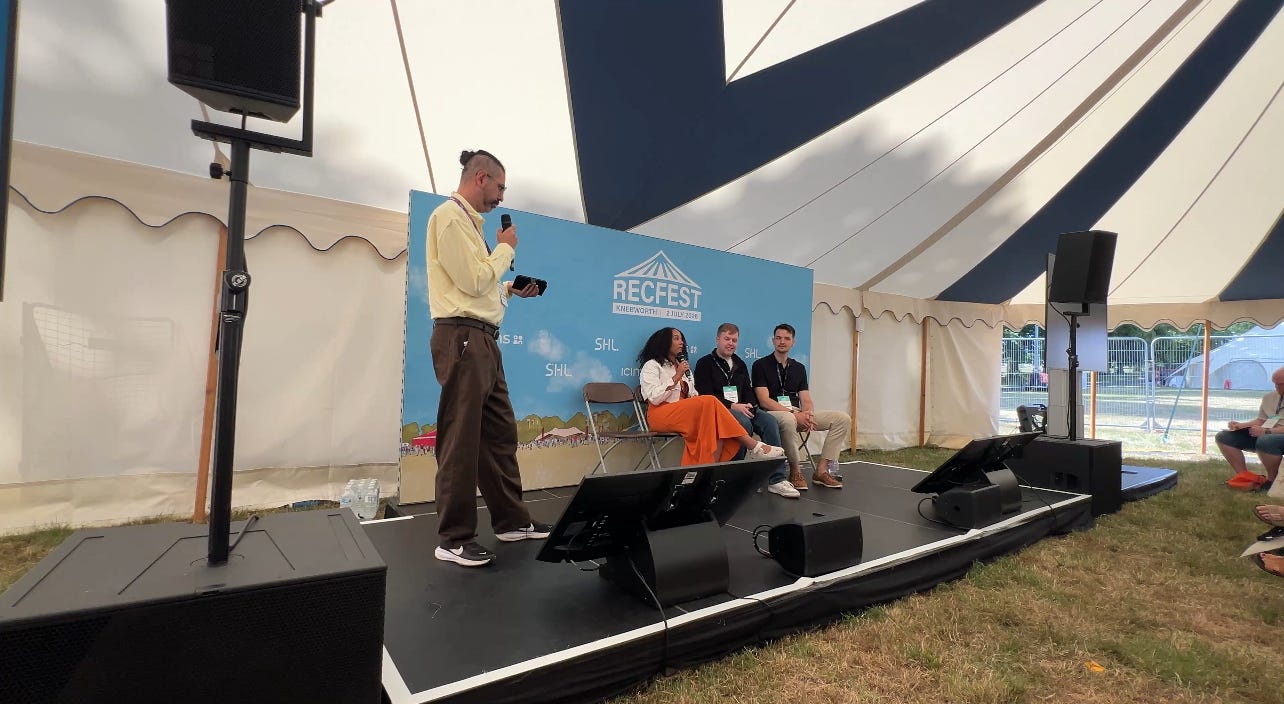
Something else from the panel was a great piece of advice wrapped up in a story - an intern who, within weeks of starting, built something that generated $100,000 for the business. That kind of story moves people far more than a slide of data ever will — exactly the kind of proof point employer brand teams should be capturing and telling, not sitting on.
ROI matters, of course — but storytelling and relationship-building are what actually position the importance and impact of early careers talent internally.
Working in employer branding in-house? You’re the orchestrator, not the owner
Over on the EVP stage, James Ellis and Audra Knight brought some big energy about employer branding in-house. Treat employer brand as a business tool, not a TA tool or an internal engagement nice-to-have — if you can use it to solve an actual business problem, you become far more relevant in the room.
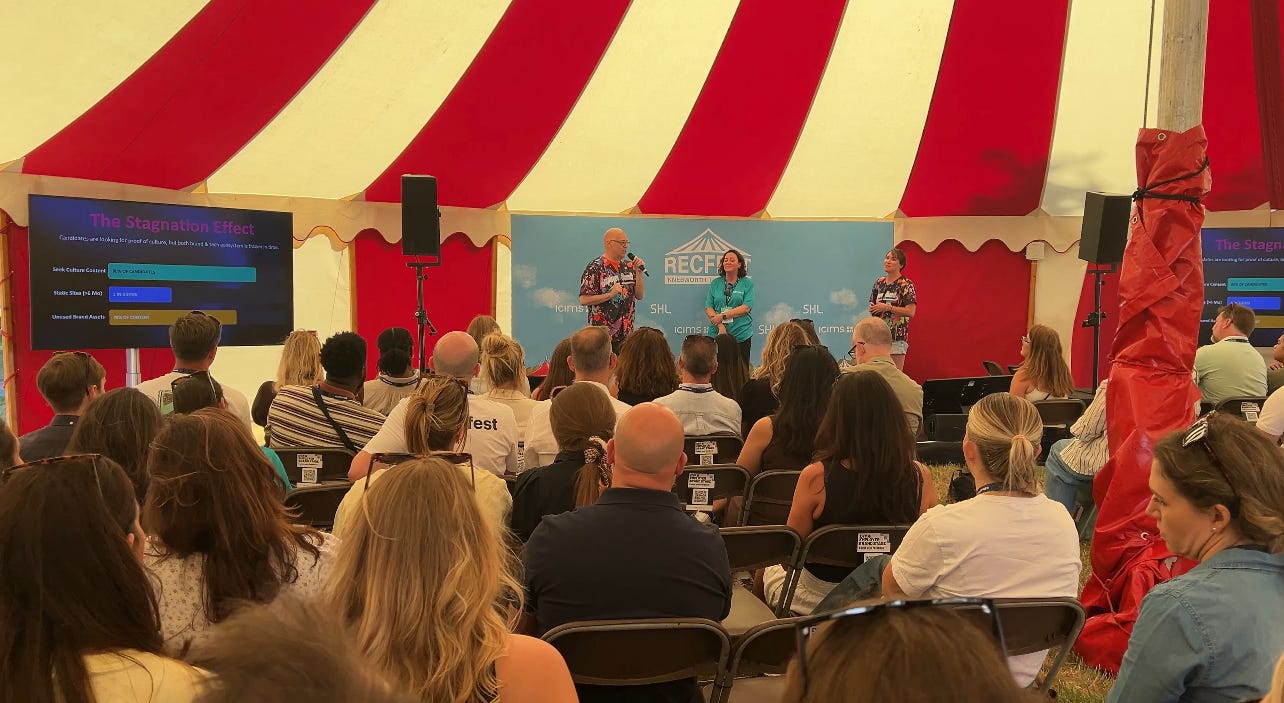
There was a brutal little exercise thrown out to the audience: use ChatGPT to look at your website and ask it to pull out the key messages. Now do the same for your competitors and see the difference. The results will likely tell you that differentiation is lacking more than it should be in employer branding.
There was a comforting message for EBers. Often, employer branding comes down to one person or a small team. As an employer brand person, you don’t have the authority to tell the whole business what its story is — you’re the orchestrator, not the owner. This really resonated with me - the job is surfacing the knowledge and experience that’s already sitting inside teams and giving it a shape. That’s also, not coincidentally, exactly the point I keep making about content: it’s not a bolt-on to a business strategy, it’s the front end of it.
Culture and EVP: the Mars bar analogy
“Insight to Impact with Great Place to Work: Building an Authentic EVP Rooted in Culture Data,” with Claire Knights (Chief Growth Officer, Great Place to Work) and Vicki Saunders (Founding Director, The EVP Consultancy), was a really interesting session on the foundations of authentic EVPs.
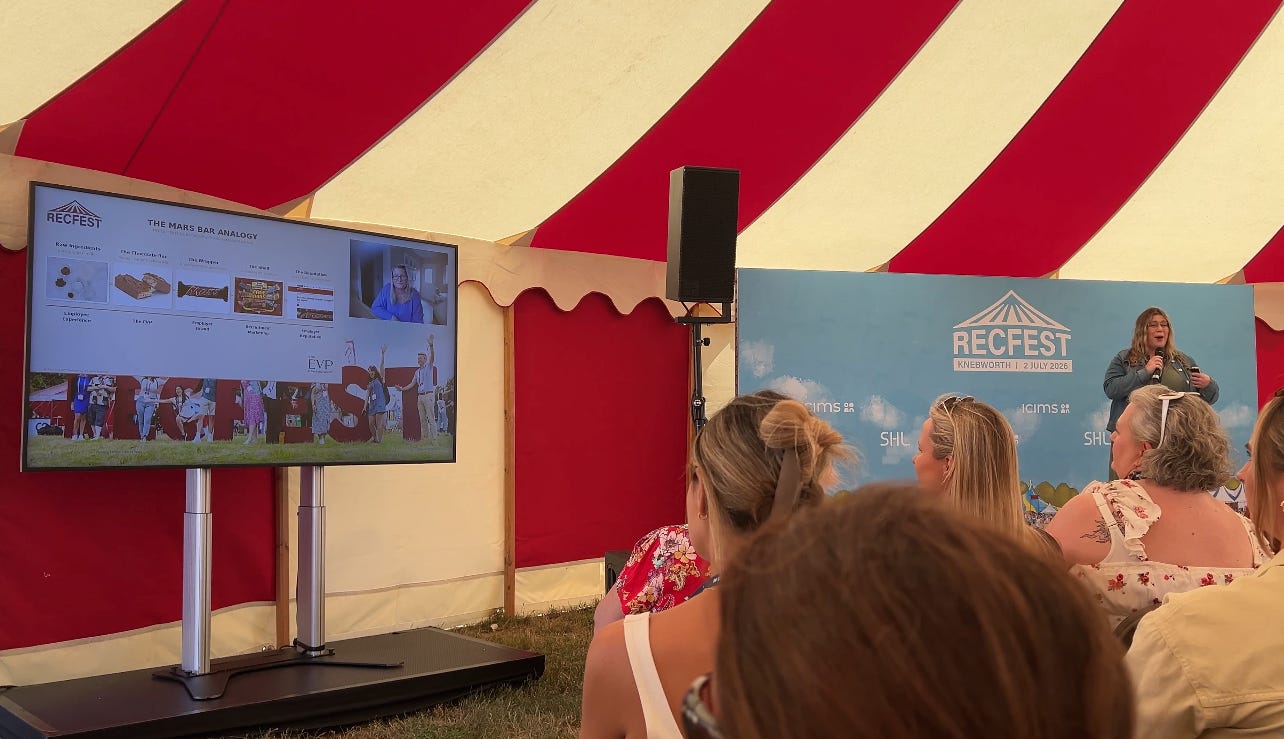
It was interesting to see that Great Place to Work doesn’t just see themselves as an accreditation body handing out badges — it’s a data company.
And the analogy Vicki used is that of a Mars bar: the ingredients, the bar itself, the wrapper, the tasting, and the reviews. You can have the glossiest wrapper in the industry, but if there’s no substance in the bar, people find out fast — and increasingly, so does AI. In a world where LLMs are shaping how candidates form opinions about employers, generic marketing language with no proof points behind it just won’t land.
Interrogate your data, find your proof points, and look at the long-term pattern rather than a single good year. That’s what makes an EVP true rather than a campaign — and the payoff has multiple benefits. Internally, people believe it because they can see it’s real, which kills cynicism. Externally, the wrong people self-select out before they apply, and the right people arrive with fewer surprises when they join.
Conversations between the talks
The conversations flowed from the tents to in between the agenda, and here are some of the things we talked about in the July sunshine.

On the agency model. A properly interesting conversation about whether agencies still need to be the size they used to be, or whether a leaner model — bringing in the right specialist at the right moment — is actually the better way to work now. AI and monetisation: If AI makes things quicker does that mean agencies should charge less? Yes, and no - it depends. But AI in the hands of someone who doesn’t know a specialism produces something generic, but AI in the hands of someone who really knows their craft produces something sharper. That’s a big case for partners with real knowledge working alongside in-house teams.
On the science of storytelling. A great conversation about understanding how people actually react to content, rather than just what they say they think about it — looking at the physical, almost instinctive response to a piece of video versus the polite feedback you get when you ask someone’s opinion of it afterwards. It’s a good reminder that there’s real craft and science behind storytelling that works. Even when plenty of it can be done in-house, it’s worth investing in content production experts, while also building your in-house capability - both help each other.
On employee-generated video. A conversation about the real barrier many in-house teams face with video — it’s rarely desire, it’s headspace, resource, time and capability. In-house teams who decide to “do video” often only realise what it actually takes once they start doing it themselves. That’s important for internal learning, and it shows that software which helps employees generate their own content really helps — but so does having the bandwidth to manage the process. Using partners in the right way can make all the difference.
On hiring for storytelling. I chatted to a global brand who’d hired for a senior storytelling role a few months back — and what’s interesting is that the role sits in comms, not TA. So it’s not just a TA thing — storytelling is something that covers multiple touch points in a business, and therefore brings value in multiple places. Building the business case is about looking at the true strategic impact and ROI to the business. Companies are full of stories, so it’s genuinely great to see it being taken seriously, and I hope more follow suit. I’ll be picking this up in a future podcast episode.
TA as a strategic partner? Amazon shows how it’s done
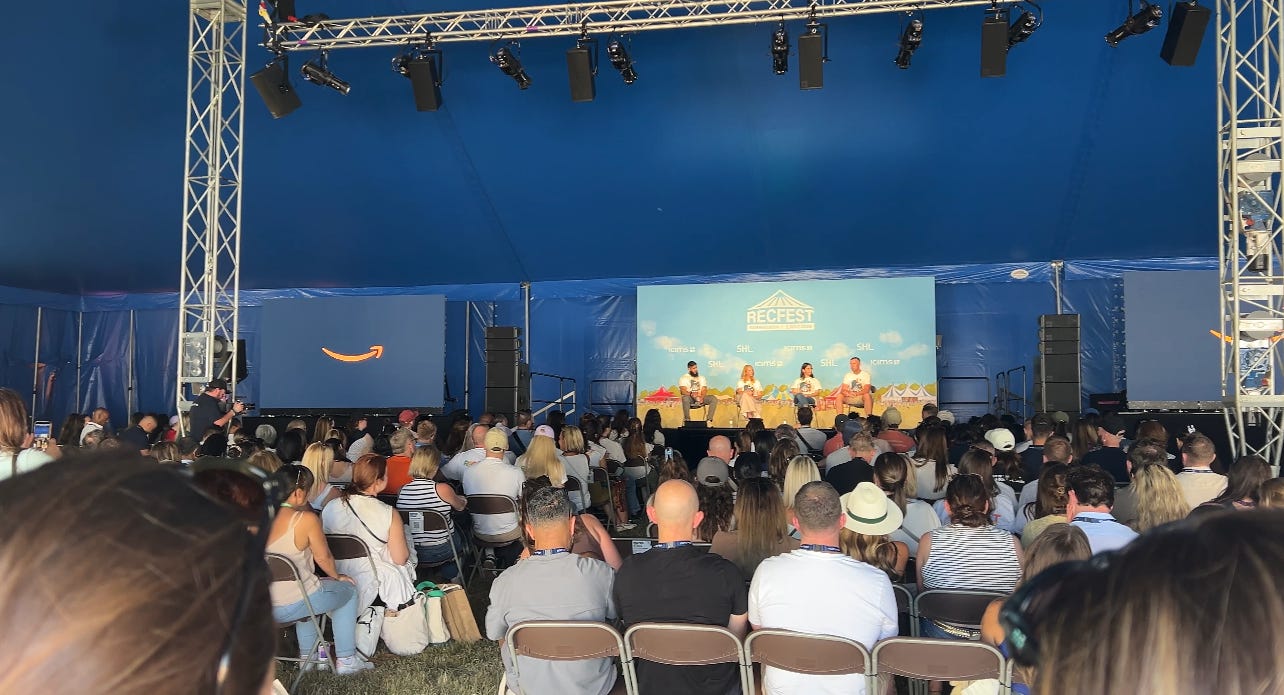
Amazon took the Inspire Stage to talk about moving TA from vacancy filler to strategic business partner — it’s great to see this shift actually happening, and it’s not just conference talk. The question they left the audience with was a great mic-drop moment: If your business removed the TA function entirely, what would it lose beyond the ability to hire?
If you’re struggling to answer that, it’s worth taking a proper look at how TA can genuinely help the business.
It was great to see a panel of people actually making this happen — especially from a company like Amazon.
The answer keeps coming back to the same place: have a deep understanding of what the business actually needs, and build relationships with stakeholders across it. You can’t just ask TA questions — you have to ask business questions.
AI is smart, humans are genius
This session took aim at the traditional recruitment processes as ways to spot the people who are actually going to help a business grow through thinking differently and dealing with unknowns. As AI takes over the more “logical” parts of the process there’s a danger of making things too logical. Tom Stevenson - Founder & CEO at Pynea made the case for assessing people against a future problem instead of asking questions with a clean, Google-able or LLM-able answer. Open-ended questions are harder to fake and harder for AI to answer generically on someone’s behalf — which gives you a good read on how someone thinks.
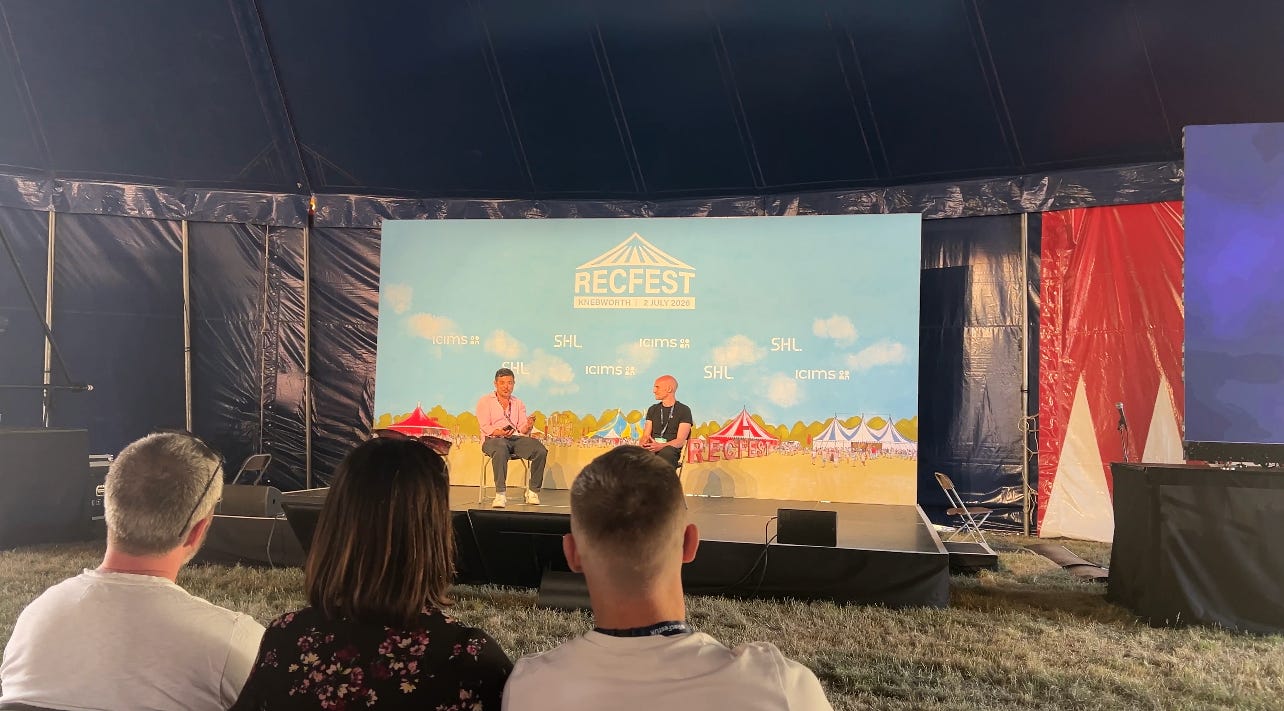
My take: Hung and Tom’s point about CVs — that they capture a record of achievement but not the trait or mindset behind it — connects straight back to content. If you’re creating opinion-led, story-led content that genuinely shows what it’s like to work somewhere and who succeeds there, you’re doing some of that assessment work before a candidate even applies. People self-select in — or, just as usefully, self-select out.
Closing out at the EVP stage
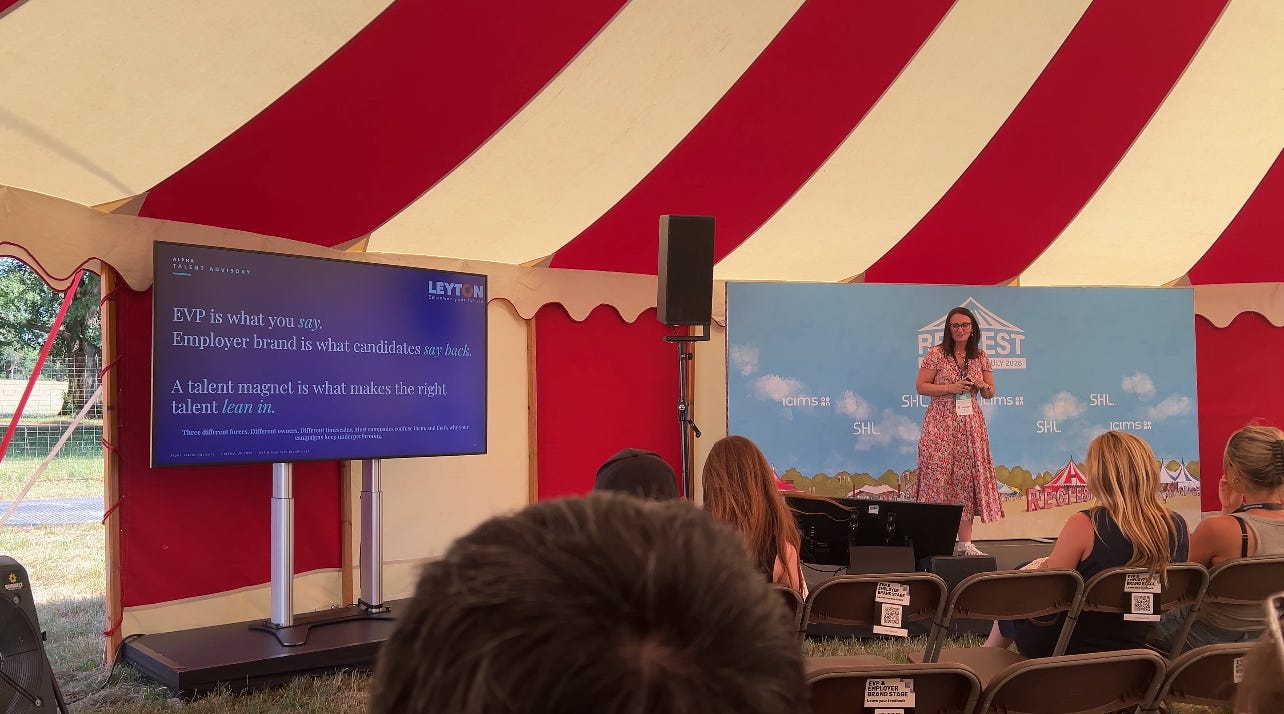
The last session of the day? I went back to the EVP tent. A hot field, music getting louder outside, drinks flowing, and a speaker who said she was nervous but didn’t show it once she got going.
Nicola Plenderleith - Head of Talent Acquisition at Leyton - was great. She gave practical, take-it-away-and-do-it-Monday advice, and her core point was simple: your EVP isn’t the polished version you’ve built, it’s whether that promise actually shows up at every touchpoint someone experiences — from the first conversation with a hiring manager, to whether your career site would still be recognisably you with the logo covered up, to the rejection emails you send out. Go back and reread your own rejection emails. Do they sound like boilerplate, or do they sound like you? That was a genuinely good way to close the day.
The Lean Guide to Employer Content
I’d brought a few copies of my recently published book: The Lean Guide to Employer Content along with me for the day, and it was great getting it into people’s hands and talking about the why and what of it. The response was a valuable reaffirmation for writing the book.
If you’re in talent acquisition or employer branding and want a framework to build self-sustainable content creation in-house then you can find out more here.
Why I love going to events like RecFest
The big takeaway for me is that it’s worth going to events like this.
It’s a rare chance to meet multiple people in one place, and to take your team along so they can learn from others too. And it’s just as important to have some good conversations and a few drinks in the sun — it might not feel like work, but stepping back and actually enjoying yourself is exactly what sends you back to work with energy and focus.
If you see me at an event, pop over and say hi.
Chris
Host, Employer Content Marketing
Founder, Content Marketing Pod Ltd


