

If anyone were handing out awards for phrase of the year in employer branding and TA, I reckon “doing more with less” would be up there as contender. The phrase has been around for years, but AI hasn’t helped in the way we’d have hoped. On top of expectations that weren’t realistic in the first place, there’s now an assumption that AI should let you do even more.
Meanwhile you’re still answering to leadership, recruiters, hiring managers and comms, and content has to squeeze in somewhere between them.
For a lot of in-house teams, content is part of the job rather than the job itself. (In reality, it’s a full-time job.) That’s why I’m always pleased when I see organisations hiring content specialists or building small content teams in-house. Raising the profile of in-house practitioners, especially the people making the content, is something I’ve cared about for a long time.
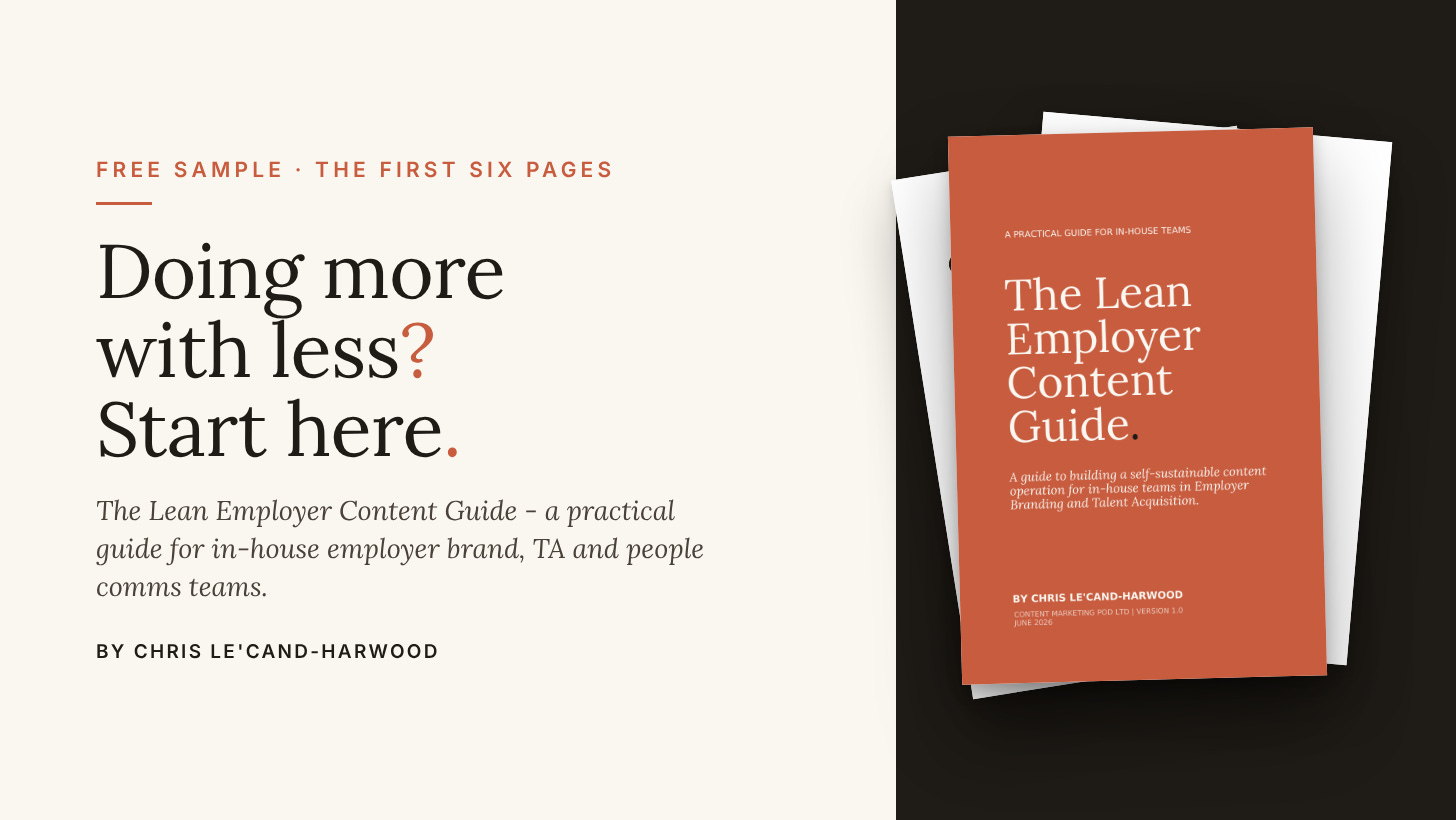
They’re the people I wrote The Lean Employer Content Guide for. I opened it with the line I’ve heard more than any other across 155+ episodes of the Employer Content Marketing podcast: “We’re under pressure to do a lot with limited time, budget or resources.”
What readers have said so far
Since the guide came out in the summer, copies have gone to readers in the UK, Canada, the USA, Austria, Slovenia and Romania [and yes, my mum on her request!]. It’s great to see it travelling. Here’s what a few readers have said.
“Fantastic from the first page to the last! Simple and direct. Can’t wait to kick off my 4-week sprint 🤩”
— Melissa Macfarlane Heidmiller, Talent Brand and Employee Advocacy, Canada
“Practical, honest, and clearly written from lived experience rather than theory. The lean philosophy applied to employer content is long overdue - and the production stack section alone is worth the read for most in-house teams.”
— Andy Lambert, entrepreneur, exited founder, ex-Adobe, and author of Spheres of Influence
“The Lean Employer Content Guide cuts through the noise and focuses on what actually matters: creating content that attracts the right people, builds trust, and supports hiring goals without unnecessary complexity. A practical resource for employers who want to communicate more effectively.”
— Stephane Mehmet, Global Talent Acquisition Leader
Getting this kind of feedback really is wonderful, and I particularly loved Melissa’s, because getting people to actually start is what the guide is for. Every chapter ends with five things to try that week, and the 4-Week Sprint Toolkit at the back gives you a plan for your first four weeks.
A chance to step back as we approach the end of the year
With the end of the year coming up, it’s a good moment to look at how your content is set up - the strategy behind it, and how the work gets done each week. I hope the guide helps with that. The lean way of working in it means starting small and seeing how your audience responds before you put real time and money behind anything. As I say in the book, life is not an A Level exam, and your content plan doesn’t need to be one either.
Here’s something to get you started
I know a 90+ page book is a big ask when you’re short on time, so I’ve pulled together a free sample. It’s six pages from the start of the guide, and you’ll get through it with a cup of coffee or tea.
It opens with that line about pressure and why I wrote the guide. Then there’s the contents page, so you can see how the whole framework hangs together, followed by who the guide is for, what I mean by test, learn and scale, and a section on the content attention crisis.
Download the free sample