

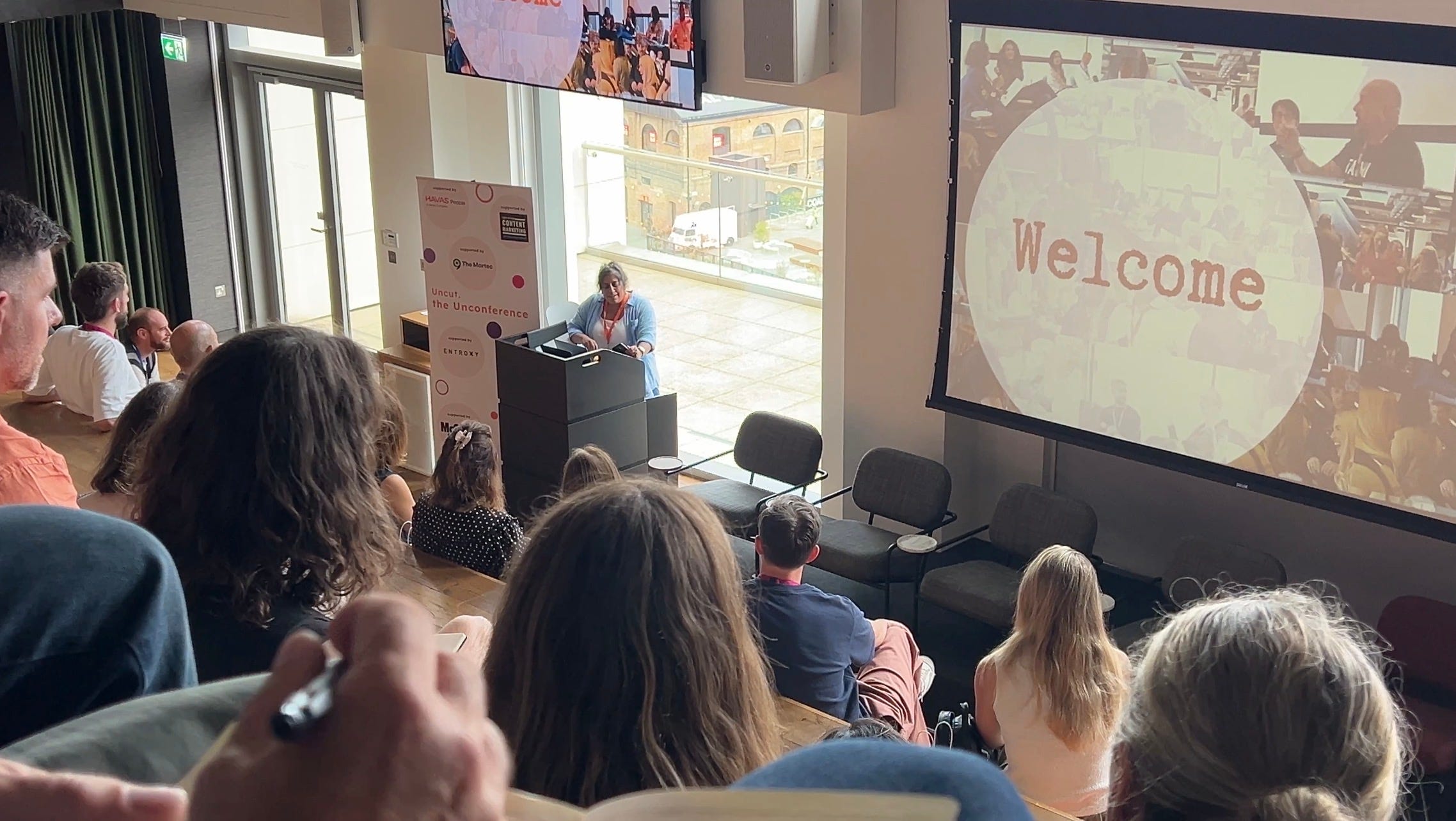
Spending time together in person is really valuable, especially for small teams and solo practitioners. That’s something well understood in employer branding.
That’s why events like The EB Space’s Uncut [Un]Conference matter so much for the employer branding community - and why it was great to return to Havas People for the second year running.
What Claire’s built here is fantastic - more on that later, when I share my conversation with her from the end of a long day.
Here’s what stood out for me, with my own take thrown in where I’ve got one.
[A quick note: as this was a safe space for conversations within four walls, I haven’t gone into detail of who said what specifically - but I want you to get a feel for the themes discussed, and hopefully it encourages you to join future events].
AI Won’t Replace Employer Brand...But It Might Replace Average Employer Branders
Right off the bat, we took on the massive topic of AI - it’s unavoidable, weaving its way into life, society, and work like the internet on steroids.
Will AI replace employer branding, or just the people who do the things it can now take on? One interesting opinion was that the job description for an “average” employer brander doesn’t really exist anymore, and addressing that is down to leadership - understanding what the discipline needs to look like in a world with AI in it, which means a willingness to embrace change.
AI isn’t there to replace what already exists - it’s there to scale it. Research is a good example: AI has massively increased the practical capability available to employer branders, though the output still needs checking. AI shouldn’t replace strategy, but it can support it by accelerating the research strategy is built on. What it shouldn’t replace is the underlying skills - you need those first if you want to use AI well.
Creativity came up too - there’s something inherently human that AI can’t replicate, and a real danger of everything starting to look the same when people lean on it too much. My take: that danger exists with humans too - the result being corporate jargon and empty messages - it’s why my fellow podcaster Chris Murdoch started a podcast called Employer Bland - love that title.
A big piece was seeing AI-generated creative work that’s technically fine but missing the punch of great human creative - and that shows up in performance, not just looks. One example: a video where an employee hesitated on camera, the editor offering to smooth it out - but it was the hesitation that needed to stay in. I said it myself in the LinkedIn comments on this event last week: those imperfections are perfect. AI would remove that - and that’s something we see far too often in employer branding.
My take: the hesitation story is less about AI. It’s an editing-philosophy point that AI just happens to have made more visible. Polish a moment too much, whether by algorithm or editor, and you lose the heart and soul.
Who Are You Without Your Job Title?
This session was a good example of the difference this conference brings to the employer branding space - a conversation that really helps everyone reflect and get value from other people’s experiences.
One thing was about how you introduce yourself to someone. In the UK, the instinctive question is “what do you do?” - but less of a thing in other countries. A job is, no doubt, a big part of our lives. It shouldn’t define you - though it can be part of your identity.
As personal branding becomes more important, presenting yourself matters - but only if it’s true to you. Being one person online and someone totally different in person is the real issue. Your reputation is real, so stay true to yourself - it’s you who works with colleagues and peers day to day, not your online persona.
The conversation encourages everyone to think about how they introduce themselves - not job title first, but something distinctive or genuinely part of who you are. From writer to coffee drinker to curious person - these all help us be more us. The conference lived this out - there were no job titles on name badges, just your name and an icebreaker question.
My take: the unpolished, real version of a story is almost always worth more than the manufactured one.
Pitch Slapped: What Nobody Says About Agency-Client Relationships
It’s really refreshing to hear this topic discussed openly at an industry event - it’s something a lot of people in employer branding feel and go through, but rarely say it out loud.
One theme was that clients sometimes forget an agency has other clients, breeding unrealistic, ASAP expectations. But agencies often get selected precisely because of the variety of clients they work across - this isn’t always acknowledged once a client assumes they’re the only one being served.
In-house teams often navigate internal approval chains agency people don’t see, which can explain a lot of the back-and-forth that frustrates people on the outside. Empathy on both sides is the answer.
Then there’s the balance between answering a brief exactly as given and offering what you think is the right solution. Is an unanswered brief a misunderstanding, or a genuine push toward something better? The answer, I think, is clarity: a short conversation, before or after the brief lands, avoids the email ping-pong of second-guessing each other.
There was a great audience question: should companies pay agencies to pitch? My own view: it pushes companies to select the right ones in the first place, and it shows a respect for time, money, and contribution from day one. But agencies need to position themselves clearly enough that companies know who to invite in the first place too.
Culture Isn’t a Content Strategy
Employer brand can tell powerful stories, but it can’t fix culture on its own. This session explored the tension between what we say externally and what people actually experience internally.
This was a really interesting session for me, considering I live in the employer content space - I often say I’m about helping organisations turn workplace culture into content. Employer brand doesn’t fix culture; the truest expressions of it are strategy and communications simply wrapped around a culture that already exists.
One of the POVs from the panel wasn’t just to communicate culture anymore - it was to actually shift it. My first reaction: agencies can talk all day about influencing culture, but they’re rarely embedded deep enough inside a business to move it through branding alone. Real change happens from really being in the inside.
The panel’s conversation built toward something similar. Spin collapses the moment employees stop believing the story told about their workplace - and if they don’t believe it, candidates won’t either.
Another key point was how company values get interpreted differently around the world. Real co-creation with local teams matters - if you don’t localise the meaning, it just becomes hollow.
My take: I’d frame the title differently - “Content strategy isn’t your culture, but it can help bring it alive.” Your culture already exists, good or bad, and content’s job is to give it a pulse, out loud, through real engagement with the people living inside it. Done well, the vibe comes through implicitly - and it cuts both ways, because the people who wouldn’t fit sense that just as clearly as the people who would.
The Debate: Employer Brand Is Dead. Long Live Reputation
2pm is when energy at an all day event usually dips - so this debate injected some spiciness into the room. Speakers were told which side they had to argue seconds before talking on stage, which made for some afternoon chuckles.
One argument centred on control - employer brand is what you can shape and own, while reputation is largely what happens to you. The counter-argument leaned on consumer trust: would you trust the company selling the air fryer, or the hundreds of reviews saying it burns your fish fingers? There was a very timely political comparison too - reputation is Kier Starmer, whereas Employer Branding is Andy Burnham.
One more point was that AI is now doing candidates’ research for them, stripping away even more control.
Part of the debate spilled into a different question - where employer brand should actually sit within a business. This age-old question could have been a session in its own right, so I picked it up with Richard Gordon afterwards.
Where should employer brand sit in an organisation? Listen to Richard Gordon 🔊
Richard worked both agency-side and across several different companies in-house, and I wanted his view given that breadth of experience. His take: there’s no universally right answer. He had a case for sitting within Talent & Learning, since housing EB only inside TA narrows it to attraction, without asking whether the external story holds up once someone’s inside the building.
The Candidate Trust Crisis
It’s great to see this topic discussed so openly - because for everything we do in employer brand and talent, the candidate is ultimately a huge part of it.
AI came up again: candidates using it to apply at scale and game the system, while companies use it to assess applications at the same scale - a trust crisis sitting right in the middle. But it’s just as much about ghosting, vague job descriptions, and the gap between what’s promised and what candidates actually experience.
One point that stood out for me was that this erosion of trust starts even earlier than the job market itself - tied to a broader decline in trust in institutions like universities, accelerated through COVID.
My take: the fix is mostly unglamorous. My mum and dad always said please and thank you doesn’t cost anything - and that’s what can get dropped first when teams are stretched and AI becomes “the answer’.
EB Therapy - Closing Q&A
This session is another good example of why this event is great - pre-submitted questions from all delegates were put into a box and plucked out for answering.
Two questions stood out for me. Are careers sites still necessary? Yes - but the role is shifting fast given how much job discovery now happens through AI. My own view: they need to stop being a build-it-and-forget asset and start operating like a living editorial hub. The other: how job search behaviour itself is changing.
There were plenty of other questions and side conversations too, and that was a great way to end the day - focused purely on value to the people attending.
And Relax: A Conversation With Claire de Souza After Another Epic Day 🔊
As the [un]conference wound down, I grabbed a drink and managed to catch Claire to find out why she gives up this much extra time, in an already busy life, to keep making this happen.
Here’s our conversation:
She really cares about doing this, and wants to build a space for genuinely good, unpolished conversation. What she’s built is deliberately hand-made, down to gluing lolly sticks onto cards and stuffing sweets into bags in her living room.
Claire wants people to leave with more than a goody bag and pages of notes. She wants them feeling a bit challenged, and a bit refreshed. Nothing beats human connection - very true, Claire!
It was a great event, and I’m super glad to have been part of it again. Keep an eye out for other events by The EB Space.
Chris
Host, Employer Content Marketing
Founder, Content Marketing Pod Ltd