

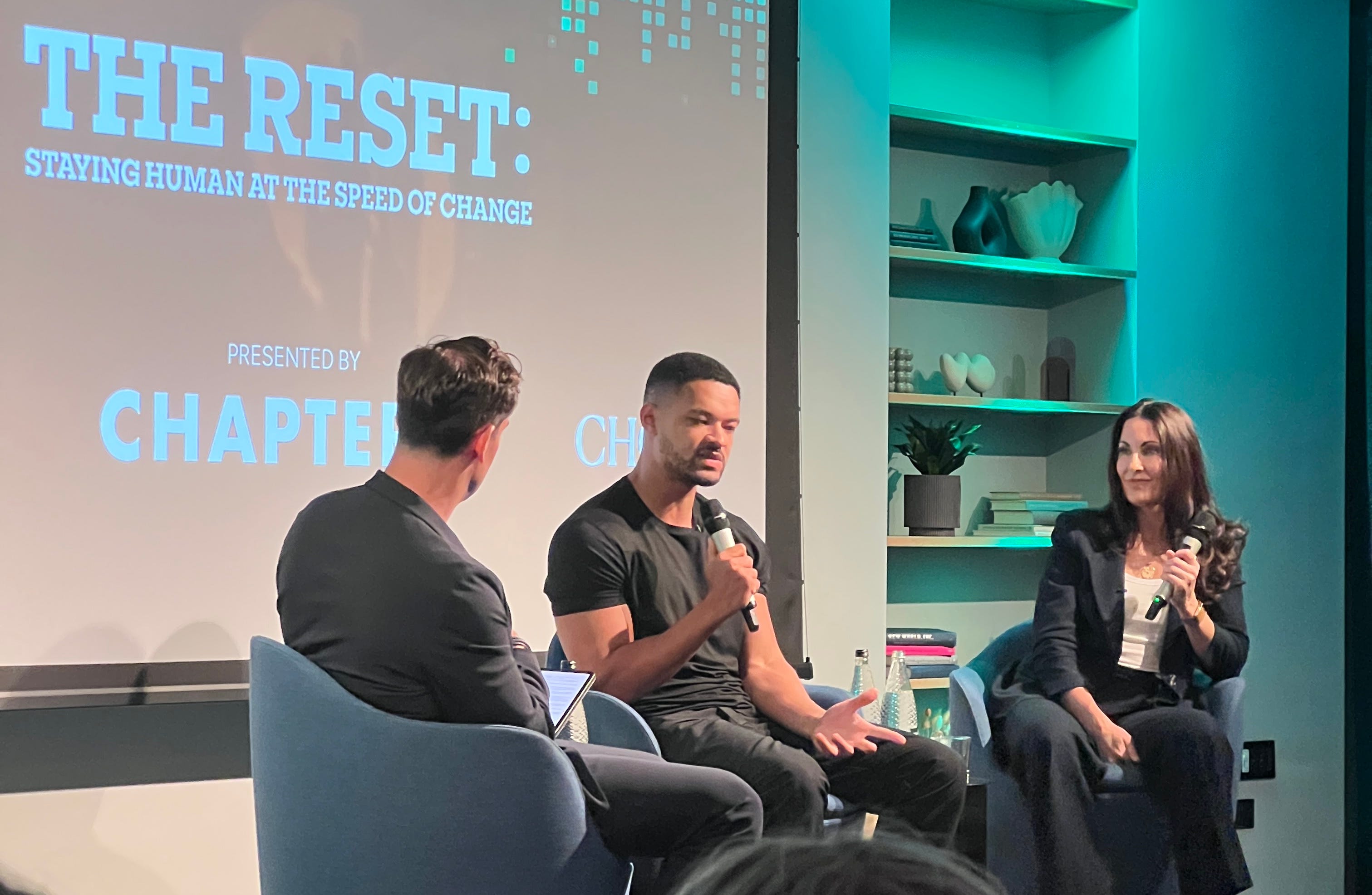
So last week I found myself on the 22nd floor of 22 Bishopsgate in a room with about 300 other people, looking out over London while Steven Bartlett and Dr Kristen Holmes got comfortable on stage.
The event was called The Reset. Chapter 2 put it on, and Nick Homer kindly invited me along so I thought I’d share some of the gems from the stage.
The room was full of CHROs, CPOs, Heads of People, Directors of Talent Acquisition and Heads of Talent Acquisition. That tells you something — two names pulled this crowd out for a Thursday night. That doesn’t happen often these days.
The conversation on stage was one that’s on the mind of many: what leadership skills help you succeed when AI keeps reshuffling the deck?
Over the next hour or so, Steven and Kristen went in a load of directions. Failure. Humility. 1% gains. Psychological safety. Storytelling. Hiring that actually predicts how someone will perform rather than how they want to be seen. The big thing: being human is the moat, and the organisations built for this decade are the ones willing to question everything, experiment constantly, and push through the paper walls.
I filmed five segments of the conversation. Here they are:
Why “unromantic” leaders are going to win the AI decade
Steven went in hard early doors with this one.
His argument: if the correct answer to every part of your business is now changing faster than it ever has, you cannot afford to be romantic about how you do what you do. Stay romantic about the impact. Be completely ruthless about the process.
Then he tied it to identity. “Someone would rather go to the ends of the earth than make an edit to their own identity,” he said. Because our identities are our harbour. They’re where we feel safe. But in a world where new AI models drop every week and yesterday’s correct answer is already wrong, that harbour quietly becomes a liability. Cue cognitive dissonance — the brain’s reflex to reject whichever piece of new information threatens the old one. It happens to leaders. It happens to their teams.
So what do you do about it? His answer: experiment at a ridiculous rate, fail openly, and build a company where humility runs top to bottom. Flight Story literally has a Head of Experimentation and Failure. They track the number of experiments and failures they run, and the job is to get that number up. “Kill the guesswork” is apparently a phrase the interns use as fluently as the CEOs.
And he was refreshingly honest about the personal cost of getting this wrong. His first startup failed, he said, because he couldn’t bring himself to admit he was wrong. That stuck.
Have a watch.
Scaling WHOOP from 30 to nearly 1,000 through high intensity and high humility
When Kristen joined WHOOP there were 30 people. There are now nearly a thousand, and they’re hiring another 600 this year. In the meantime they’ve switched their model, switched their subscriptions, and gone from a hardware business to a software one.
So when she talks about change, she’s knows all about it.
Ask her what has actually held through all of that and she points at two things. The values they hire for — “high intensity, high humility” — and a flat-out willingness to experiment in public. Loads of what WHOOP has tried has failed.
What you see now as a neat suite of features is really the result of an enormous amount of trial, error and tweaking.
Celebrating the small things is big thing for the business. WHOOP runs a gratitude ritual at the start of every meeting. You thank someone. It has to be someone outside your team. It loops back round through HR. They’ve got a Slack channel where the little wins get celebrated.
On paper, it may sound fluffy. In practice, Kristen’s point is that the work is unglamorous most of the time, and psychological momentum is the thing that keeps people going when nobody’s clapping for the big stuff.
Worth a listen.
Psychological safety, storytelling, and spies
I couldn’t stop recording this stretch of the conversation. So it’s the longest segment, but worth the time.
Kristen kicked off with the research. Google’s Project Aristotle found psychological safety was the defining trait of their best teams — and those teams produced $4.5m more than the average. Her point: bring it up as a bottom-line conversation, not a wellness one.
Then Steven talked about something fundamental to us humans - storytelling. Facts and stats don’t really move people. Stories do. He’s interviewed a lot of former spies for his Diary of a CEO, and they all say the same thing: the real skill is listening. Andrew Bustamante - a former CIA Agent - told Steven he could get your secrets in nine months, starting with a casual bump-in at an event… exactly like this one.
Then he tied it back to his own company. Flight Story disbanded their innovation team and embedded innovators across every department, wrapped in a simple story: our people have magic in them, and our job is to remove the stuff that isn’t.
His take on failure: focus on the input, not the output. Reward the attempt. They’re literally building a hall of failure. Classic Bartlett.
Have a watch — there’s a lot in this one.
Hire the people who push through “paper walls”
Steven’s “paper wall” idea worth hearing about.
He’s sceptical of psychometric tests that ask if you’re ambitious. Of course you’ll say yes. He wants to know what you’d actually *do* in a specific, awkward situation. So his company built a culture test using real scenarios. Every answer sounds reasonable on paper. Your biggest client’s locked out of Instagram on a Saturday and the only person with the password is on honeymoon — what do you do? A supplier says delivery has slipped from four weeks to six. Do you scale back, push it out, or ask why it takes six weeks?
His most successful people ask why. They push through the paper wall.
He cited Amancio Ortega moving Zara’s supply chain from nine months to 14 days. Most thought this would be impossible but he pushed on. And Bernard Sado was told men would never wheel suitcases — until he sold them to women first. The first queue at the retailer was mostly men. Now 99% of suitcases have wheels.
120,000 people have taken Steven’s test. He says he’s never found a better predictor of performance, in either direction.
Watch him explain it.
Why you should clap for the air freshener
1% gains. They really do make a difference.
Flight Story has a Slack channel where the team literally claps when someone makes a change that looks petty on the surface. Jemima swaps the air freshener in one of the podcast studios. Somebody posts. Clap and flare emojis all over the place.
1% changes look petty in foresight and obvious in hindsight. He gave one example — they changed seven seconds at the top of *Diary of a CEO*, and the view-to-subscription rate went up 178%.
His argument: chasing big step changes is demoralising because they’re rare. Chasing small ones is motivating because they happen all the time, and they compound. That’s a culture you can build on purpose.
A good night out
The Reset was well worth the trip into London. 300+ people in one room, along with the great conversations, really gave me energy. AI is changing the game in front of our very eyes, so to have such influential and engaging humans on stage was really valuable.
And I always enjoy bumping into familiar faces and meeting new ones!
Big thanks to Nick Homer for the invite, and to Leo Harrison and the Chapter 2 team for putting the night on and running it so well.
Chris
Chris Le’cand-Harwood
Host, Employer Content Marketing
Founder, Content Marketing Pod Ltd
How can HR directors help conservative senior management separate their professional identities from outdated approaches in practice, so that the company can smoothly test new ways of working?