

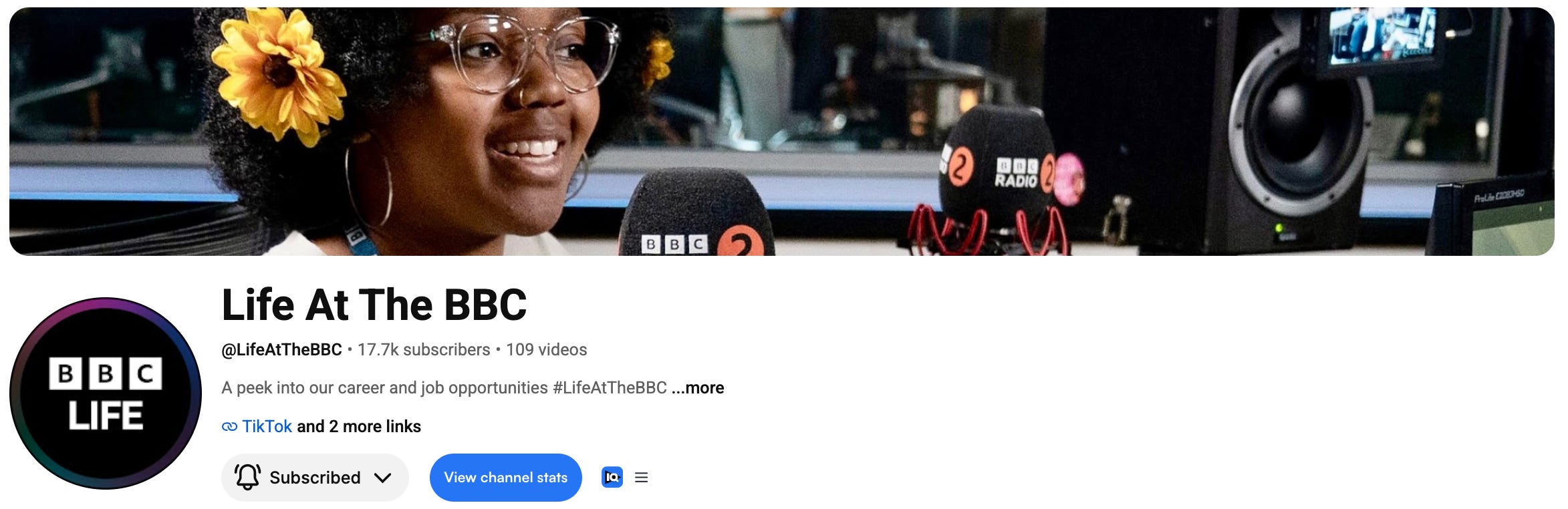
There’s a YouTube channel called Life At The BBC.
If you haven’t come across it, it does exactly what it says on the tin — a peek behind the curtain at one of the world’s most recognisable organisations. Who works there. What they actually do. What it feels like to be part of it.
Over the last few months they’ve been quietly putting out a stream of YouTube Shorts. Short, punchy, filmed simply. And if you work in employer brand or internal comms, I recommend spending twenty minutes with them — because there’s a masterclass buried in there.
Here’s what stands out.
The setup is deceptively simple
The first thing you notice watching these Shorts is that nobody’s spent a fortune on kit. It’s sometimes a walk-and-talk through a familiar BBC location. And sometimes a quick explainer from someone in a craft role you’d never normally hear from.
That’s intentional because one of the biggest excuses I’ve heard from in-house teams is that they can’t do video properly without a production budget. The BBC is proving otherwise, week after week, on a short-form format that anyone with a camera and a subject can replicate.
The format is a permission slip to crack on. If they can do it lean, so can you.
But the content goes somewhere most employer content doesn’t
Here’s what I find really interesting.
The Shorts aren’t just “here’s what it’s like to work here” fluff. They lift the lid on what the BBC actually does — the craft, the decision-making, the experience of being inside a big, complex organisation with a lot of moving parts.
That’s a different angle. Most employer content stays surface-level: the office looks nice, the people are friendly, there are good benefits. This is my day full of commuting, coffee, lunch and maybe a hint of the work in between. Tick, tick, tick. The BBC content goes deeper. It shows process. It shows expertise. It treats the audience like grown-ups who are genuinely curious about how things get made.
This content goes from “here’s our culture” to “here’s how we work” — and I think it is one of the most underused moves in employer branding. It builds credibility in a way that a careers page can never quite manage. People don’t just want to know what it’s like to work somewhere. They want to know what they’d actually be doing.
Building intrigue
There’s one more thing working in the BBC’s favour, and it’s worth naming honestly: the organisation itself carries intrigue.
People are curious about what happens behind a Strictly camera, or inside a BBC news studio, or in the writers’ room on a flagship drama. That curiosity exists before the content starts. The Shorts plug straight into it.
You might be thinking: that’s easy for the BBC. We’re not a household name.
Fair point — but only partially. Every organisation has things that would genuinely surprise an outsider. The decisions that happen in the room. The skills that nobody associates with your sector. The moments where your people are doing something quietly extraordinary. Most of it never sees the light of day because teams assume it’s not interesting.
It is. It just needs someone to find it and film it.
The BBC’s advantage is a head start on intrigue. Your advantage is that your story is probably less told — which means there’s more room to surprise people.
Here are more of their YouTube Shorts.
What to actually do with this
If you’re building or refreshing your employer content programme, here are a few things:
Pick a format and stick to it. The BBC Shorts work partly because they’re consistent. The audience knows what they’re getting. That predictability is an asset — it builds a habit of watching.
Go beyond culture, into craft. Find the people in your organisation who are genuinely good at something specific, and put them on camera explaining it. Not their job title. What they actually do. The granularity is what makes it compelling.
Let the organisation’s reality be the story. You don’t need a narrative overlay or a clever concept. What happens at your company every day is already interesting. The job is getting it out of people’s heads and onto screen.
Use the short format as a discipline. The constraint of short form forces you to find the single sharpest thing in any given conversation. That’s a skill worth building — and it applies well beyond short-form video.
A note on where this fits
This piece is part of a series I’m running through the rest of the year — looking at organisations doing employer content well, and pulling out the thinking behind it. Some are household names. Some aren’t. What they have in common is a clear instinct about what they’re trying to do and why.
If you’re working through how to approach this for your own organisation, you’ll be interested in a guide for in-house teams that I’m release very soon. It’s called The Lean Guide To Employer Content, and it’s packed with guidance for in-house teams who want to build self-sustainable and scalable content functions. So if you want to know more about it then keep an eye on here or subscribe and get it in your inbox.
More to come in my Field Notes on Employer Storytelling Series. If there’s an organisation you think I should be looking at, drop it in the comments — I’m always looking for the next one.
Thanks
Chris
Chris Le’cand-Harwood
Host, Employer Content Marketing
Founder, Content Marketing Pod Ltd