

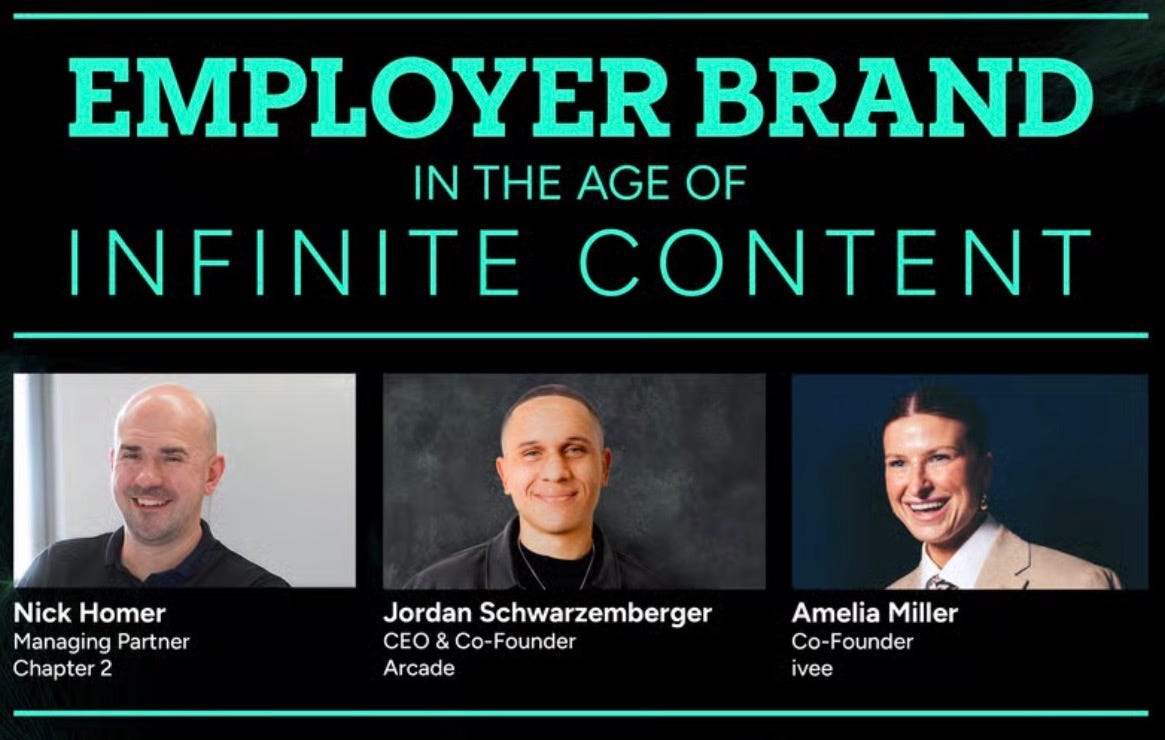
“Employer Brand in the age of infinite content” stood out on the event circuit, so I had to come along and see what the discussion was about.
As well as the topic, what stood out was the panel. Joining Nick Homer, Managing Partner - Employer Brand at Chapter 2, were two guests from well outside employer branding and talent acquisition circles, which is exactly what we need.
Jordan Schwarzemberger is CEO and Co-Founder of Arcade, the management company for Europe’s biggest creators - Sidemen (244m+ cross channel followers). And Amelia Miller: Co-founder of ivee, ex-international athlete and published psychologist.
That mix is brilliant. The more we listen to people outside our own industry, the more we learn and the more innovation happens. In that spirit, it’s great to hear Chapter 2 has launched Signal, their employer branding agency. Looking forward to seeing more about that in the coming weeks.
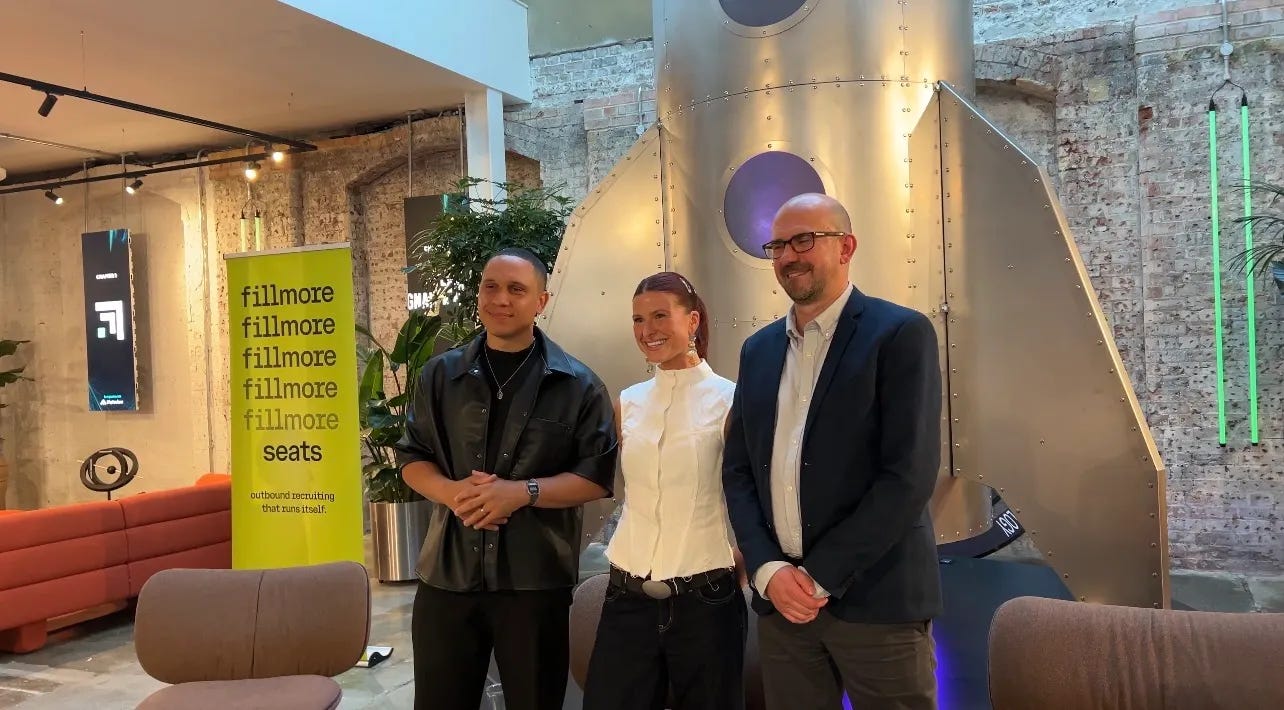
Now on to what I took away from the evening, along with my own takes.
Content saturation and sameness - supercharged by AI
It’s never been easier or cheaper to create content, which sounds like good news until you notice what it’s actually produced: a mountain of sameness, AI slop, as some call it. There’s a real danger that the industry leans on AI to do more with less, but isn’t that just going to magnify the criticism employer branding often gets? The vanilla messaging, the corporate speak, the lack of distinctiveness. A good friend of mine, Chris Murdoch, has a podcast with a name that sticks it to the sameness: Employer Bland - it sums up the challenge really well.
This is a real issue in my opinion. When you’re busy as a solo artist or small team, it’s tempting to get enticed by the efficiency of AI. Writing that would take hours now takes a few minutes. But buyer beware.
People can tell when AI is being relied on for speed more than quality. There are clear tells in AI-written content, and increasingly they’re liabilities. Watch for the tells, heavy em dashes, familiar cliches. Don’t use AI as a crutch, use it to support the work, not do it for you.
What actually helps you stand out in the sea of AI slop? The answer from the panel was to get in front of a camera, it’s still distinctive in a way AI isn’t. Focus on being genuinely unique, doing something only you can do. A great hook matters more than people think, particularly on LinkedIn, close to both science and art, usually built on a story, a pain point, and a resolution.
The other answer from the panel? Find the employees who naturally stand out, not because they’re polished, but because they have real character, real insight, and their own opinions and expertise to share. That’s where employer brand content actually competes against a sea of AI slop. And where AI does the heavy lifting behind the scenes, it frees up time for the more human part, which was never going to be replaceable anyway.
Polished isn’t the issue, corporate blandness is
TikTok has taught everyone that rough, ready and natural is what a lot of people crave. Too polished starts to feel too corporate, and trust drops when this happens. But I’d push back slightly on treating this way. You need employee-generated, rough-and-real content that’s going to really help communicate your employer brand. But high-production content can still be true and trusted if it’s built around something real, a podcast episode built on someone’s genuinely difficult experience at work, a workplace documentary shot with employees. Production values aren’t the problem. Corporate blandness is. And mixing up the formats matters if you’re going to stand out and sustain your content operations.
Content-first thinking - a mindset that changes your employer branding
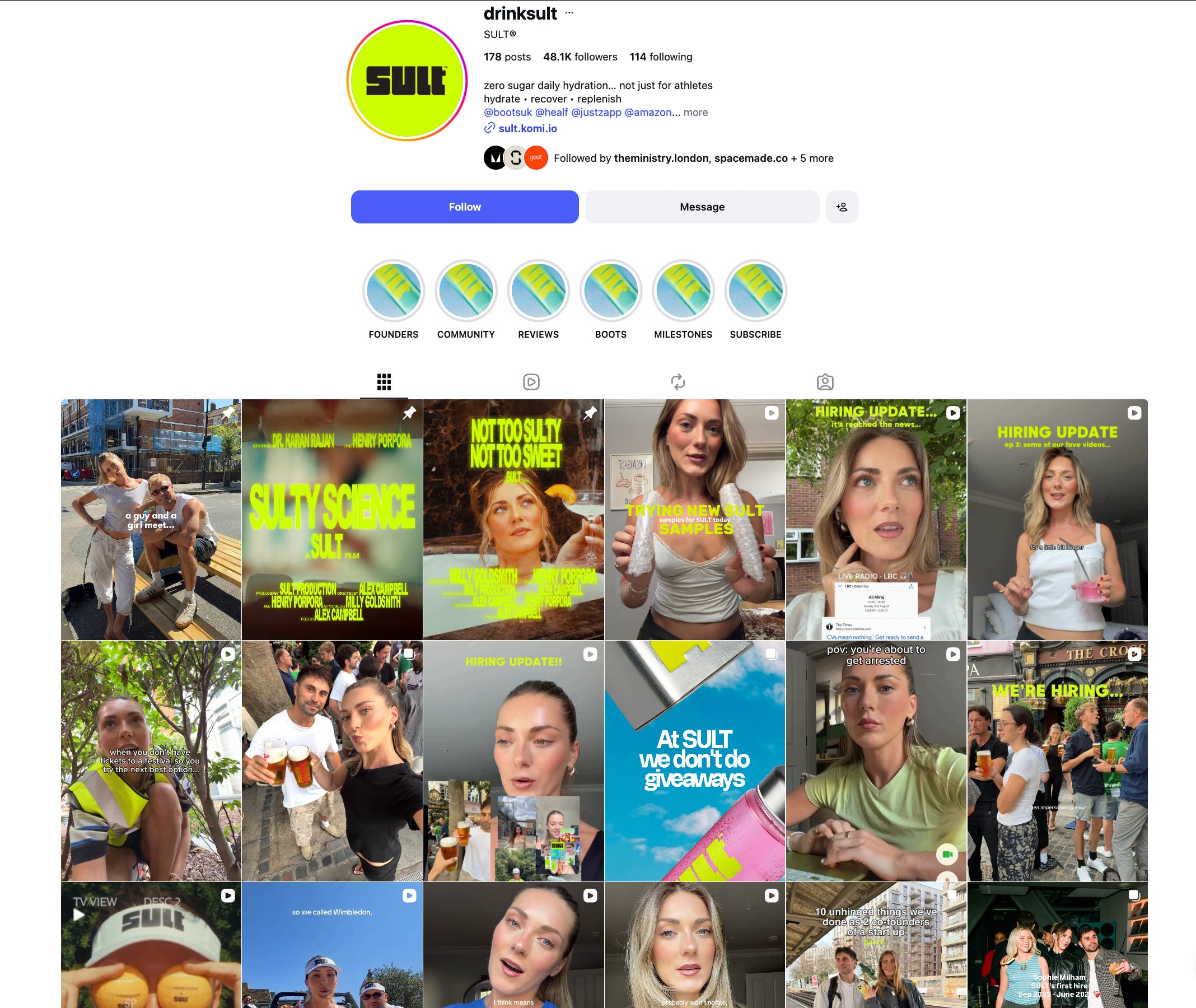
SULT, a UK hydration/electrolyte brand, came up as a good example of what the panel was talking about. Their Instagram is worth scrolling through. They are great at content and understand social 100%. When they had a role open, they didn’t post a job ad in the traditional sense. They did a video of the co-founders in the pub talking about their crazy busy week and the role they’re hiring for - they wanted videos not CVs.
This is content-first thinking. But not every leadership team does, this thinking has to be strategic, not just something that happens long after of a strategy that never mentions it.
M&S got a specific mention too, and an employee in particular: Kathryn Turner, their Director of Product Development, has built a viral TikTok presence sharing behind-the-scenes work, taste sessions and product explainers, the actual process of getting a product to shelf. Here’s her TikTok account, her enthusiasm is contagious and she’s clearly passionate about what she does.
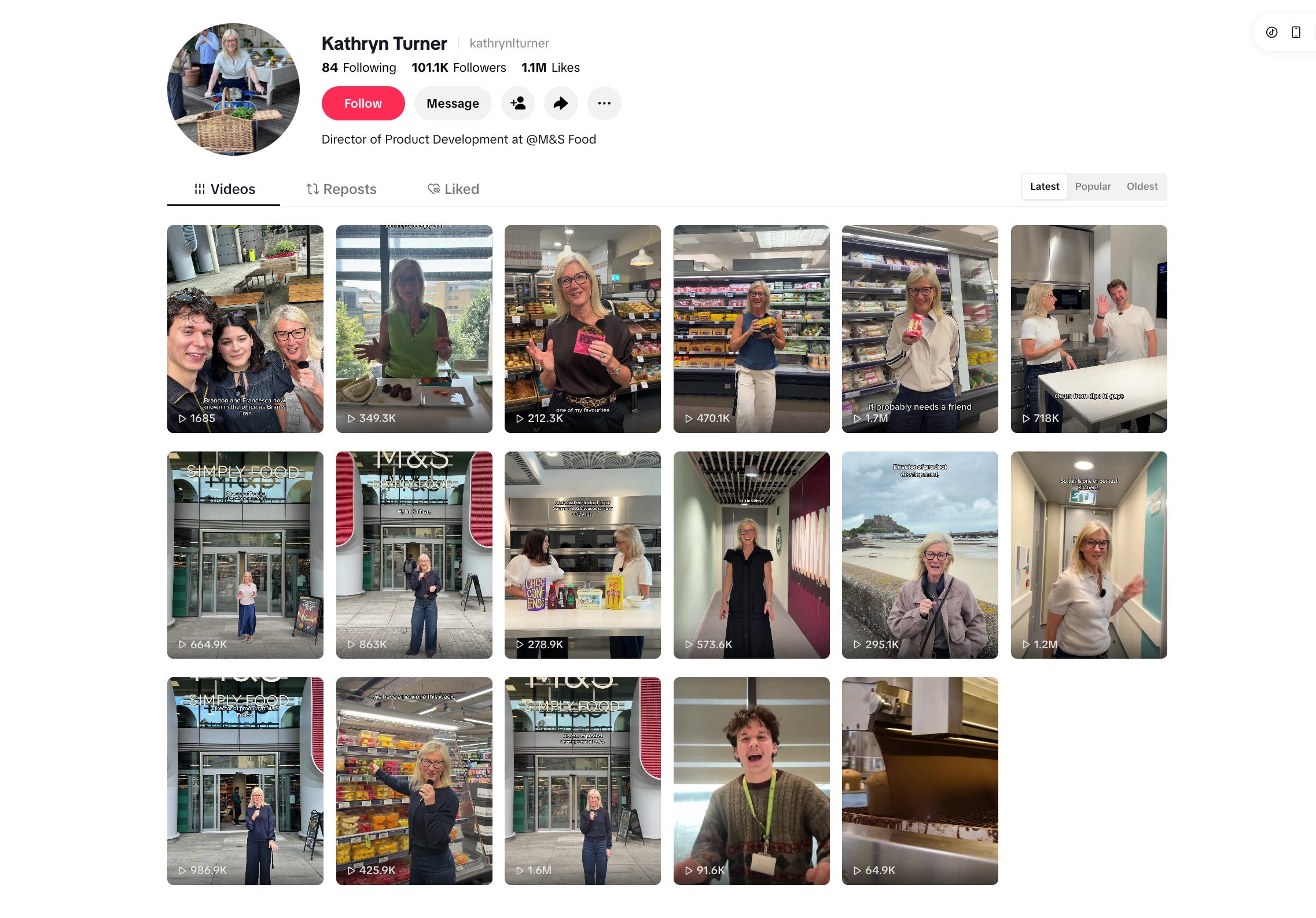
She’s only posted 16 videos but already has over 100,000 followers and over a million views and likes. It’s an amazing example of expertise as content, and of a large, established brand letting an individual represent it in their own way.
Trust is the key to your organisation’s success
How do you build trust in your brand? A big message was that if you don’t build trust through your employees, your brand will die. Strong words, but entirely understandable given that the generations now in the workforce, and driving buying decisions and influence, just see transparency as a given, because that’s what social media gave them.
That means releasing some control, trust doesn’t survive otherwise. My own take on this: we already trust employees enough to hire them. We spend real time, effort and money finding the right people. If they’re right for the job, why wouldn’t we trust them with content too?
The panel praised M&S for being one of the most trusted brands right now, partly because of its content, though it’s also decades of consistent brand investment behind that. You build trust culture by breaking the fear culture underneath most corporate content policies. Guardrails still matter, especially for leadership or older generations who need more reassurance. But psychological safety is really important, most employees hesitate not because they lack something to say, but because they’ve absorbed years of “don’t do this” policy thinking instead of a “here’s how” playbook.
How to get employees involved - find out what’s in it for them
Amelia gives every new starter LinkedIn guidance when they join. Nobody’s forced to post, though eventually they find ways to encourage people who’ve held back. The tactic of paying employees to get involved was brought up, and I think there’s real merit in that. But before you get to money, it’s worth asking honestly what’s in it for the employee. Raising their own profile. Raising their team’s profile. Visibility with leadership. Showing their expertise, internally and to current and future clients. That makes someone more valuable, wherever they end up next.
Yes, organisations worry about people leaving once they’ve built a profile. But that risk exists either way. The big question is what happens if they don’t leave, and they’re more engaged because they’re actually contributing something.
Content is a habit, not a campaign
I say this often because I really believe it: content is a habit. Be humble enough to go through a process about what works for you, and have the stamina to keep going once the first attempts don’t land. Jordan said don’t judge whether you’re any good at this until you’ve posted fifty times. Do the reps, learn as you go, and look at what other people do well and build your own version rather than starting from a blank page.
Fine advice. In my opinion, stamina is underrated in marketing, especially in employer branding, an industry that too often wants everything perfect before it starts. Most of the real learning happens through action, guided by strategy but not blocked by it. Fittingly, this event was held at Steven Bartlett’s offices, through his connection with Chapter 2, he’s an investor and partner. Amelia mentioned something Steven says: “Embarrassment is the cost of entry.” The only way past the fear of getting it wrong is doing it, and the only way it gets easier is doing it again.
The Diary of a CEO is one of the biggest podcasts on the planet, but it started with 22 episodes that nobody watched when Steven was producing them from his kitchen.
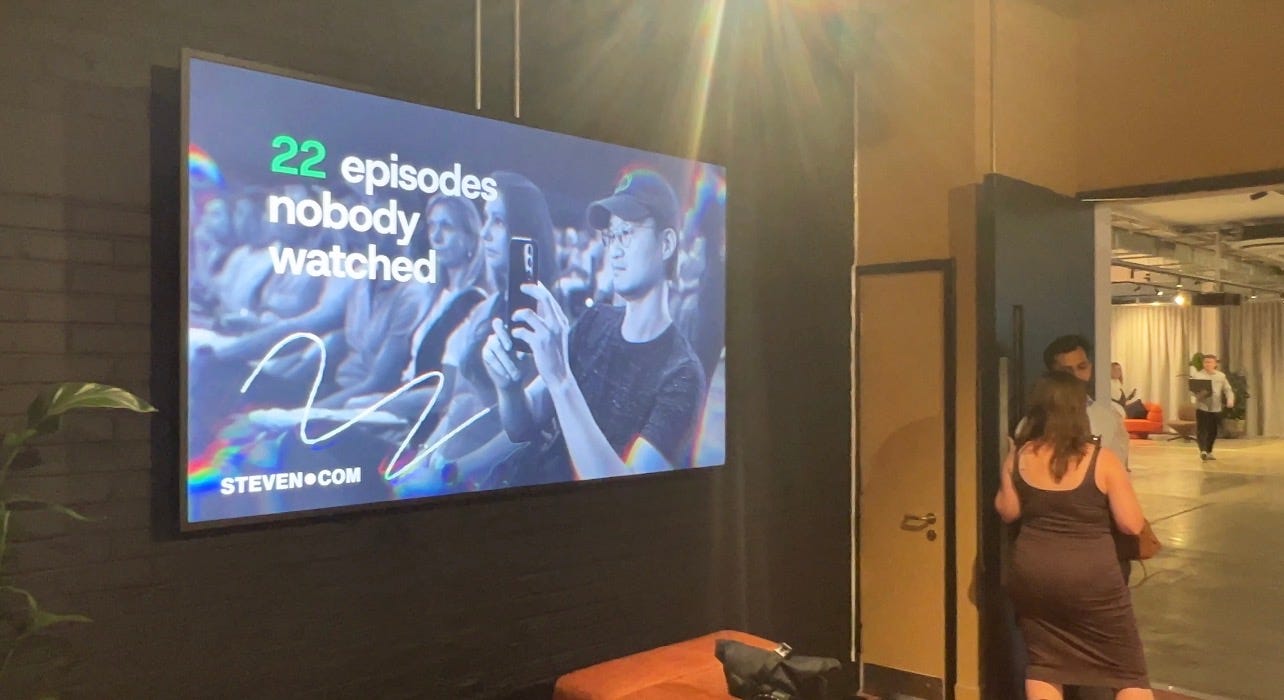
Amelia’s view was that you don’t need a big team or budget to start. She runs her company’s content with essentially one person supported by AI, and they’re building an AI agent to give employees content ideas. I’d add a caveat to that: a lot can be done by one person, but I’ve seen how much of a struggle it is where employer branding really is a team of one. AI helps for sure, but it doesn’t totally replace having the right people in place.
How much can, and should, AI take off your plate?
Jordan’s view was that the substance has to come from you, not AI, don’t outsource your thinking. Amelia challenged this, saying that if you build a sophisticated AI system that really knows your tone, organisation and context, it can support your thinking rather than replace it.
My own take is that both can be true at the same time, and I’ve learnt this a lot over the last 24 months. Give AI the right context, and don’t take its first answer as final. Great ideas usually come from bouncing things off someone else, and there’s no reason AI can’t be part of that useful friction. The point of failure isn’t AI itself, it’s opening a blank chat and typing “write a LinkedIn post about accountancy” or “write an employer content strategy for me” and hoping for the best.
So do employees need to be creators on top of everything else?
I think it’s great that employees becoming content creators is finally being taken seriously, but not everyone is ready, willing or has the time. So the scale question isn’t “get more employees creating content,” it’s finding the employees who are real gems, and building a system to draw content out of them without asking them to become creators themselves. Invite them to a meet up or a call and just talk to them, run it more like a media operation, use voice notes, run interviews.


One of my podcast guests this year was with Andy Lambert, who wrote Spheres of Influence, on how the most trusted brands win by getting employees involved. His point was spot on: ask someone to write something and they’ll struggle to find the time. Ask if they’ve got time to talk, and they usually say yes.
Rely on different content capture formats and you’ve got more chance of scaling your content operations.
AI, hiring, and the skills that sit behind an AI-supported workforce
There was a side conversation on AI and hiring, with the advice being to ask for AI fluency in candidates. I’d push that further. AI fluency isn’t just about knowing the tools, it’s the human skills behind it….the critical thinking, reasoning, knowing what to question, that determine whether someone gets anything useful out of AI at all. This makes hiring the right people even more important. AI magnifies whatever skills are already in an organisation, so you’d best be confident you’ve got the right people before you hand them the amplifier.
Standing out in the crowd - the shoe in the box
Amelia told a story about standing out from the crowd. They sent an actual shoe, in a box, to a handful of prospects, with a note: we’ve now got a foot in the door. It’s cheap, slightly ridiculous, but it’s just the kind of thing AI wouldn’t produce. In a world full of near-identical sales emails and LinkedIn posts, that’s a refreshing way of approaching it.
Events do a great job too: in-person time is inherently unique, a genuine source of content you can’t manufacture any other way. Use AI to help run the logistics if you like, but the event itself is high-touch, human stuff. It’s a bit strange we now have to actively argue for being human in our content, but given the alternative on offer, it makes sense the conversation has gone here.
The social media ban, and what fills the gap
The panel touched on the under-16s social media ban, already in place in Australia and now confirmed in the UK, announced in June. Nobody on stage was confident it’ll change much in practice, it won’t stop people using the platforms, but it might raise awareness of what social media actually does to people, particularly among parents.
An interesting question is what fills the gap once platforms are eventually forced to curb harmful content. Someone raised employer branding as part of the answer, and I think that’s right. People need content that actually helps and teaches them, and that doesn’t have to come from celebrities. Employees, sharing real knowledge and expertise, can do as similar job. We consume plenty of content from celebrities, podcasters, YouTubers, journalists. Why not employees who really know their stuff? Employer branding has a bigger job than the industry gives it credit for, in my opinion.
What would you do if you had a FTSE 100 employer branding budget tomorrow?
The advice was mainly around not defaulting to the old playbook. Agreed on that! You don’t have to always reach for the expensive research or EVP development project that takes months.
Incentivise employees to create, and give them time to do it, that’s the part organisations can struggle with.
Bring in creators who have that content-first mindset to work with organisations directly. Use AI to build employees a simple internal resource for getting involved. I saw a version of this recently while judging the Recruitment Marketing Awards, and it’s a good idea in practice.
Building a content studio in-house was another thing on the shopping list. Amelia made this point and I completely agree. It doesn’t need to be expensive. A room used once a month is enough, with someone there who has a producer’s mindset to help employees turn a conversation into something usable. Renting a studio works too, there are plenty in London, and proximity to the space is what helps gets content made - convenience for busy employees helps. This is something I talk about in my new book, The Lean Employer Content Guide. Becoming self-sustainable is really important, and having an in-house studio set up is one of the great ways to do that.
My final thoughts employer brand in the age of infinite content
Creators move fast, and that speed is exactly why brands want to work with them. Startups have fewer barriers, so the same instinct comes naturally too. Bigger organisations struggle a bit more when they try to apply this to existing structures and mindsets, but it’s worth doing.
I think the real answer sits in the middle with a tiered, media-company mindset.
Not total lockdown, with rigid guidelines and templated content. Not a free-for-all either, where every employee is expected to become a creator overnight. It’s somewhere between: keep a core of structured branded assets, let employees who want to create content do so, and alongside both, run something closer to a media operation that draws content out of busy people rather than asking them to do the heavy lifting themselves.
Do that well, and people get more confident sharing their thoughts over time, and some go on to become genuine creators in their own right, especially once the organisation sees the value and puts time and money behind it. You get control without losing freedom. And that’s the version that will make it easier to scale.
Looking forward to the next event.
Chris
Host, Employer Content Marketing
Founder, Content Marketing Pod Ltd